In 1940, Nazi Germany invaded Denmark. Thousands of miles away, the consequences reached a small mine on the southwestern coast of Greenland.
Ivittuut produced cryolite, a rare mineral used in aluminum production. The mine was the only one of its kind in the world, and during the Second World War its output became critical to Allied aluminum supply. Within days of Germany's occupation of Denmark, Canadian officials warned Washington that an attack on the mine could seriously disrupt aluminum production in the United States and Canada. The concern became so urgent that the United States established a military presence in Greenland to protect the mine.
The mine mattered because the system downstream depended on it. It sat upstream of aluminum, which sat upstream of aircraft production. A relatively obscure input had become strategically important because its supply was concentrated and difficult to replace. American military planners understood that if the source were disrupted, the effects could travel far beyond Greenland. That gave the United States an advantage in its industrial base during the Second World War.
That is the strategic power of controlling supply. When an input is abundant, companies can buy it from the market and give little thought to where it comes from. When the input becomes scarce, difficult to replace, and essential to production, the source itself becomes valuable. The strongest position is having greater control over the capacity that produces tomorrow's supply.
Companies understand this instinctively when the input is physical. A semiconductor manufacturer would never casually accept dependence on a critical-material supplier whose capacity could not expand with demand, whose quality it could not reliably measure, whose production process took years to change, and whose output every competitor was simultaneously trying to purchase. If the dependency became sufficiently important, management would begin asking whether it should secure capacity, invest upstream, vertically integrate, develop another source, or otherwise escape the constraint.
Yet companies behave very differently with an input they routinely describe as their most important: talent.
Since beginning the effort to understand and solve the talent shortage, I have spoken with business leaders across defense companies, manufacturers, technology companies, Fortune 500 companies, and other organizations shaping American industrial and technological power. Their businesses are different, but their conversations about talent are remarkably repetitive. There are not enough qualified people. Schools are not producing what industry needs quickly enough. Experienced workers are retiring. Technology is changing jobs faster than educational systems can adapt. Hiring takes too long. Qualified talent keeps getting more expensive, and competitors keep poaching the same people.
Much of this criticism is justified. What is strange is hearing company after company complain about a shortage of something they themselves make almost no attempt to produce.
Companies routinely describe people as their greatest asset while leaving the production of those people almost entirely outside their control. A school educates someone. An institution credentials them. Another employer gives them experience. Eventually, that person becomes legible to the labor market as a qualified worker. Only then does the company enter, recruiter in hand, and begin competing on price against everyone else who wants the same person.
Peter Thiel's argument in Zero to One offers a useful way to understand the problem. Thiel argues that excessive fixation on competition can trap companies into fighting over what already exists instead of creating something genuinely differentiated. When everyone pursues the same scarce resource through roughly the same methods, more competition does not necessarily create more value. It often means spending increasing amounts of money and effort fighting for marginal advantages inside a game whose underlying constraints remain unchanged.
Talent markets exhibit exactly this behavior. Companies have built sophisticated machinery for competing over finished talent: recruiting organizations, employer brands, search firms, signing bonuses, higher compensation, referral programs, and increasingly elaborate systems for finding people their competitors are also trying to find. These interventions can help one employer capture a larger share of the existing supply, but they do not increase the supply itself.
Suppose ten companies need the same hundred electricians. A better recruiter may help one company hire fifteen more. A higher wage may persuade another ten to move from Company A to Company B. A signing bonus may force every other employer to respond. Recruiting costs rise, compensation rises, and the same workers move between firms.
After all of that competition, there are still only one hundred electricians.
Electrician number 101 has not been created.
The companies have become better at redistributing scarcity among themselves, while doing almost nothing to reduce the scarcity itself. In fact, the harder they compete over a fixed supply, the more expensive that supply becomes.
That is the talent equivalent of fighting over shipments leaving a scarce mine while leaving the source of production untouched.
The more consequential strategic question is therefore not simply how a company becomes better at winning talent. It is why one of the most important inputs to growth remains so dependent on someone else to produce.
The conventional company competes for talent. The exceptional company creates its own supply.
I. Own the supply
Owning talent supply does not mean owning people, nor does it require a company to build a university or employ every instructor. In practice, controlling the supply of talent means controlling the variables that produce it.
This is fundamentally different from hiring.
Most companies enter the talent supply chain at the very end. Schools, apprenticeship programs, credentialing institutions, and previous employers develop the talent. Companies simply compete for whoever emerges, and often on price, which drives the price of talent upward.
They do not control the production of talent. They select from the supply that someone else produced.
An integrated system moves the employer farther upstream.
Exhibit 1
Talent supply architecture
Where the employer enters the system that produces capability.
Conventional model
- Human potential
- Education
- Credential
- Experience
- Labor market
- Employer
Integrated model · employer present throughout
- Human potential
- Selection
- Capability development
- Demonstrated competency
- Deployment
- Workplace performance
- Feedback
Feedback returns to selection and capability development. Workplace performance informs the system that produces the next cohort.
Conventional companies select from talent someone else produced. Integrated companies influence the system that produces it.
Some companies are already becoming less willing to leave the production of critical talent to the labor market.
Hadrian has built workforce development into its manufacturing model. Its factory operating system is designed, in part, to train what it calls a “New American Workforce” of factory technicians in thirty days or less.
Tesla does something similar in vehicle service. Its START program uses sixteen weeks of classroom instruction, hands-on training, and service-center experience to develop technicians for Tesla’s technical requirements.
Palantir has moved even farther upstream. Its Meritocracy Fellowship gives graduating high-school seniors four months to work on technical problems inside the company. Strong performers can interview for full-time roles.
These companies build different products and control different parts of the talent pipeline. But they share one important idea:
The existing supply of qualified workers is not a fixed constraint.
Instead of competing only for the people the market already produces, they have created ways to produce more of the capability they need.
That distinction matters most when demand rises.
The labor market may work well when a company needs twenty more workers. The problem may be niche roles, but the bigger problem changes when twenty becomes two hundred and fifty, or five hundred becomes one thousand.
It becomes extremely important to realize that a system that can quickly produce talent is a competitive advantage.
Every talent system has a production limit. Universities have fixed calendars and program capacity. Community colleges are constrained by instructors, facilities, and enrollment. On-the-job training can work well at modest scale, but each new trainee consumes the time of an experienced worker.
A company-built system has constraints too.
The difference is that the company can act on them.
If equipment limits throughput, it can add equipment. If instructors are the bottleneck, it can hire more instructors or redesign the training model. If too few candidates enter the system, it can expand sourcing. If trainees repeatedly fail the same competency, it can change the curriculum, assessment, or instruction.
And if demand doubles, management can calculate what it will take to double output: more candidates, instructors, equipment, facilities, and capital.
None of this is easy.
But it gives the company something the open labor market does not: a lever over the supply of talent.
That distinction can be shown.
Exhibit 2 · Illustrative
Talent supply responsiveness
How much qualified, productive supply each pathway can add as one employer's demand rises. The shapes show the relationship. They are not measured headcount.
Control matters when demand changes: can the system produce more?
Illustrative. Employer-controlled development can add instructors, equipment, facilities, and sourcing. On-the-job training flattens because each additional trainee consumes experienced-worker time. External institutions and the open market do not expand because one employer needs them to.
This is the real test of whether a company controls talent supply. The question is not whether it operates a training center, sponsors a school, or spends heavily on workforce development. The question is whether the production of capability can respond to the requirements of the business.
A genuine talent supply system therefore needs four properties.
- Sufficient volume to meet demand.
- Enough velocity to produce capability when it is needed.
- Measurable quality, so the employer knows the output can actually perform the work.
- Enough adaptability to change as the work itself changes.
Those properties convert talent from something the company merely searches for into something it can increasingly plan, measure, and produce. Instead of accepting labor-market scarcity as an external fact, management gains another option: increasing the production of the capability itself.
That is complete domination of the talent supply.
III. How to dominate the production of capability
Companies often confuse investing in talent with controlling its production. They donate equipment to community colleges, fund university laboratories, sponsor apprenticeships, and help pay for new programs. These investments can strengthen the workforce and serve students well, but paying for a pipeline does not give an employer control over what comes out of it.
Schools and employers answer to different needs. A university must consider accreditation, faculty governance, degree requirements, academic calendars, and student demand. A community college serves students, taxpayers, the state, and many employers at once. A company has a narrower requirement: it needs a certain number of people who can perform certain work, to a defined standard, by a certain date.
That distinction matters when talent constrains the business. Suppose a new plant needs one thousand technicians next year. If the program produces only four hundred qualified workers, who can increase capacity? If graduates repeatedly fail the company's technical assessment, who can change the training? If an instructor consistently produces poor outcomes, who can intervene?
These are questions of control.
The lesson from Ivittuut applies here. The strategic value of the mine came from securing influence over the source of future supply, not from purchasing more cryolite after it had already reached the market. Talent is similar. A company controls its supply only when it has enough authority over the system that produces capability to shape both the quality and quantity of its output.
If they successfully control, they will dominate the market.
Define the output and design backward
Control begins with a clear definition of what the system is supposed to produce.
A capability system starts with the work itself. What must the person be able to do? What level of precision, judgment, independence, speed, and safety does the work require? How can those abilities be demonstrated?
Once the output is clear, the rest of the system can be designed backward from it.
Exhibit 3
Design backward from capability
Employer-controlled capability system
- Work
- Required capability
- Competencies
- Assessment
- Instruction
- Selection
Traditional sequence
- Curriculum
- Coursework
- Credential
- Presumed capability
Start with the work. Design backward from the capability required to perform it.
Credentials can remain useful signals, and some are legally required. But the production system should ultimately be organized around demonstrated capability rather than the assumption that a degree, certification, or number of years automatically proves competence.
Control the production variables
Defining the output is not enough. The company must also control the variables that determine whether the system can produce it.
That does not require owning every school, facility, or instructor. A university, community college, private training company, apprenticeship provider, or outside instructor may still operate parts of the system. What matters is who holds the decision rights over the result.
Who determines who enters? Who defines the competency standard? Who controls what is taught? Who decides how performance is assessed? Who can change an instructor or instructional method when results deteriorate? Who can expand capacity when demand rises?
The clearest test is what happens when the system fails. If quality falls, throughput misses the target, or the work changes, the employer must have a mechanism for correcting the problem rather than merely recommending that someone else do so.
Exhibit 4 · Illustrative
Control matrix
Who controls the variables that determine capability production?
| Purpose-built system | On-the-job training | Community college | Four-year university | |
|---|---|---|---|---|
| Candidate selection | Direct | Direct | Limited | Minimal |
| Competency standards | Direct | Shared | Shared | Minimal |
| Curriculum | Direct | Shared | Limited | Minimal |
| Assessment | Direct | Shared | Limited | Minimal |
| Instructors | Direct | Shared | Limited | Minimal |
| Capacity | Direct | Limited | Limited | Minimal |
| Corrective-action rights | Direct | Shared | Limited | Minimal |
The issue is not who owns the classroom. It is who can define the standard, govern the process, and fix the system when it fails.
Illustrative comparison of decision rights, not a survey of particular institutions. Direct control, shared control, limited influence, minimal control.
Ownership of assets is optional. Control of outcomes is not.
Control must also extend to capacity. A company that can reliably produce fifty excellent technicians but cannot produce five hundred still does not control the supply required by the business. If demand doubles, management should be able to identify the bottleneck, calculate what additional resources are required, and increase output accordingly.
Hold competency fixed and let time vary
Once the output is defined and the production system is controllable, time should become a variable rather than the standard.
A two-year program is not effective because it lasts two years, just as a twelve-week program is not effective because it is fast. The relevant question is how long it takes a person to reach the required standard without weakening that standard.
Competency is the constraint. Time is the variable.
Someone who already possesses a skill gains little from spending weeks relearning it. Someone who has not mastered a critical task should not advance simply because the semester has ended. Different people may require different amounts of time to reach the same level of capability.
The Navy's nuclear training pipeline provides an extreme example of this production logic. Highly technical work is broken into defined capabilities, taught deliberately, assessed against a standard, and corrected before people assume operational responsibility. Companies do not need to imitate military training, but the underlying principle is useful: complex capability can be produced systematically when the output is clear and the system is organized around achieving it.
Measure time to productivity
Treating talent as a production system also changes what should be measured. Instructional hours, courses completed, and credentials awarded are intermediate measures. The business ultimately needs productive capability.
The relevant question is how long it takes to move someone from entry into the system to the point at which that person can perform useful work independently and to the required standard.
That is time to productivity.
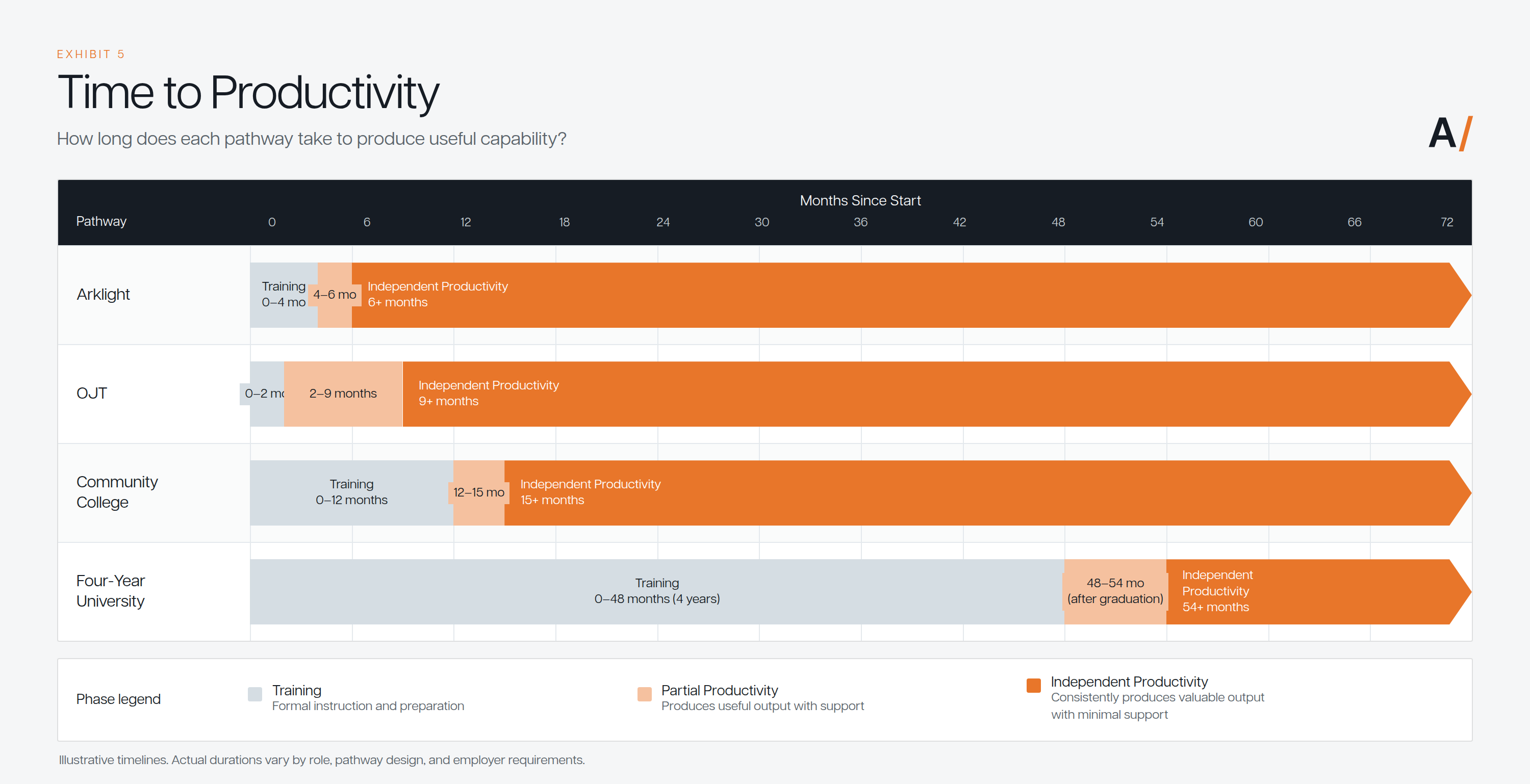
The relevant metric is not program duration. It is time to productive capability.
Two systems may graduate the same number of people while producing very different amounts of useful capacity. One may require eighteen months before workers become independently productive. Another may produce the same capability in six. Formal completion may look similar, but the underlying production systems are not.
In the Ivittuut case, control did not mean possessing every unit of cryolite already extracted. It meant securing influence over the source capable of producing more. Talent works the same way. A company controls its supply when it can define the capability it needs, govern the system that produces it, increase output when demand rises, and correct the system when performance falls short.
IV. The economics of talent supply
Owning the supply is an advantage. The next question is what it costs.
Vertical integration should only be pursued if it creates an economic advantage large enough to justify the cost and complexity of building it. A company should not build a talent system because its executives dislike universities, nor because a workforce partnership looks good in a press release. The economics must work.
And to understand whether they work, companies need to stop comparing the wrong numbers.
Tuition is not the cost of talent, nor is the recruiter's invoice. Neither is the amount spent training a single person. Those figures measure inputs into the system. The economically relevant output is productive capability. Getting there means accounting for three layers: the cost of yield, the cost of speed, and the cost of scale.
This distinction matters because different talent pathways place their costs in different places.
Exhibit 6
Visible cost, and the cost easily overlooked
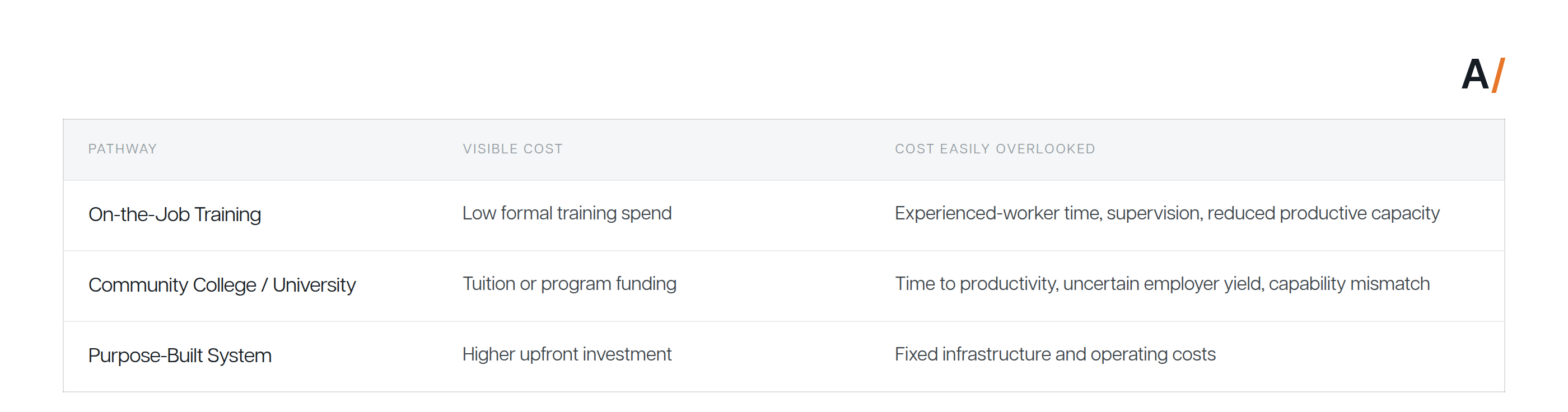
Looking only at the price a company is invoiced therefore creates a misleading comparison. Each model can appear inexpensive by ignoring costs that occur somewhere else in the system. The better comparison is the total cost required to produce the same amount of productive capability.
Consider two programs. Program A costs $5,000 per trainee. Program B costs $10,000 per trainee.
At first glance, Program A appears twice as efficient. But that comparison ends at the moment the check is written. It tells us little about how many trainees ultimately become productive workers or how long it takes them to get there.
Give both programs the same assignment instead: produce one hundred competent workers who remain through their first year.
Now the economics look different.
Exhibit 7 · Illustrative model
The real cost of 100 productive workers
Same assignment: produce 100 competent workers who remain through their first year. Program B costs twice as much per entrant and far less in total.
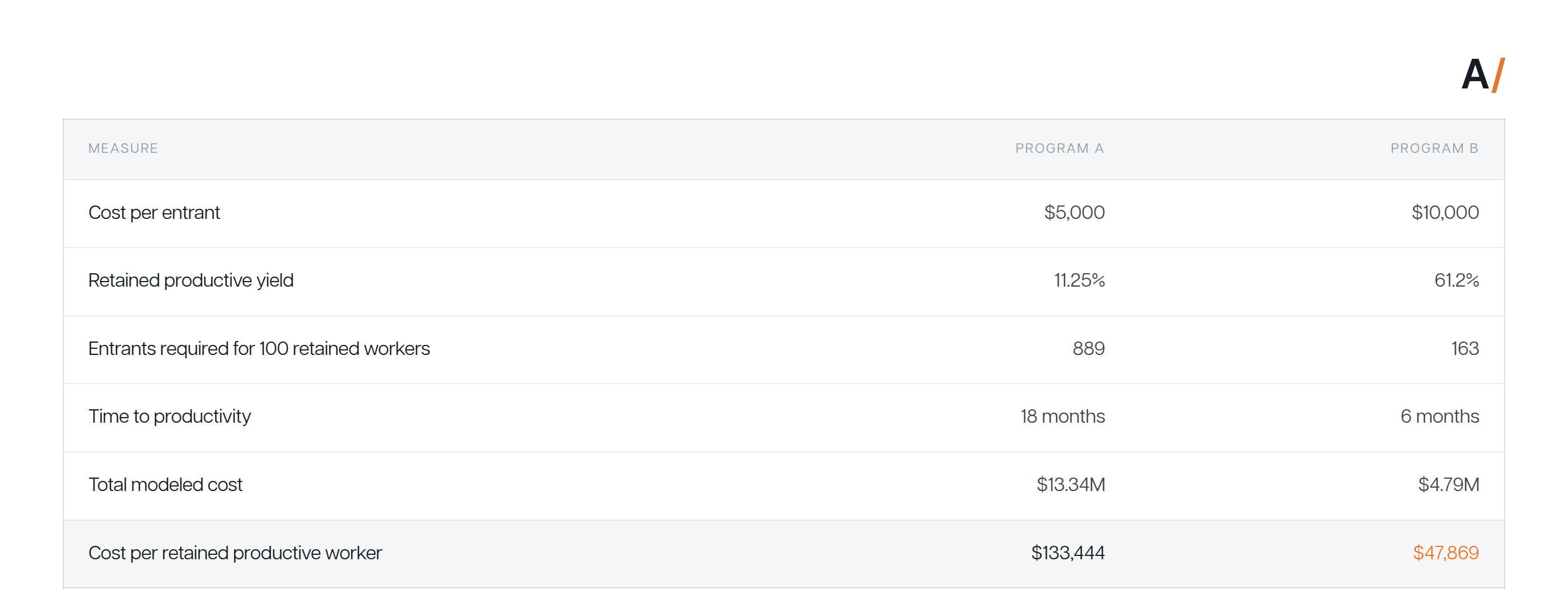
Program B costs twice as much per entrant, and produces the required workforce at a much lower total economic cost. $133,444 versus $47,869 per retained productive worker.
Illustrative model. Not representative of a particular institution or pathway. Program A assumes 30% completion, 50% competency among completers, and 25% first-year attrition. Program B assumes 80% completion, 90% competency, and 15% attrition. Modeled totals include extraordinary supervision and an assumed economic cost of delayed productive capacity.
The program that appears twice as expensive at entry becomes substantially cheaper when both systems are judged against the same output.
The difference comes down largely to two things: yield and speed.
Yield: how much of the input becomes productive?
Not everyone who enters a talent system becomes a productive worker. Some leave before completing. Some complete but do not reach the required competency. Others become competent but leave before the employer receives enough value from the investment.
The process can be reduced to a simple sequence: entered, completed, competent, productive, retained. Every transition can reduce the final yield.
Exhibit 8 · Illustrative
Where does the talent supply leak?
Two systems begin with the same hundred entrants. Ribbon width is the number of people. Gray is who leaves at that step.
The company does not need entrants or graduates. It needs productive capability at the end of the system. 100 entrants become 11.25 retained productive workers in Program A, and 61.2 in Program B.
Illustrative, normalized to 100 entrants. Completion, competency among completers, and first-year retention are the assumptions in Exhibit 7. The essay does not assume a separate loss between competent and productive, so those two stages stay equal.
In the illustration above, Program A ultimately retains 11.25 productive workers for every hundred entrants. To produce one hundred retained workers, it therefore requires approximately 889 people to enter the system. Program B retains slightly more than 61 productive workers for every hundred entrants and needs only about 163 entrants to reach the same output.
This is why cost per trainee can be misleading. The company does not ultimately need trainees, enrollments, or even graduates. It needs people capable of performing the work. A system that spends less on each entrant but requires far more entrants to produce the same number of productive workers may be considerably more expensive.
Speed: when does the capability become useful?
Yield tells us how much productive capability emerges from the system. It does not tell us when that capability becomes useful.
A worker who becomes independently productive eighteen months from now is not economically equivalent to the same worker becoming productive in six months. During the twelve-month difference, the company must either operate without the required capacity or replace it through overtime, contractors, additional supervision, delayed production, or some other substitute.
The exact cost will vary by company and occupation. The principle does not.
Every month between the need for capability and the arrival of productive capability carries an economic cost.
Exhibit 9 · Illustrative
The cost of time
Modeled economic cost of delayed productive capacity for 100 missing workers, at an assumed $50,000 a year each.
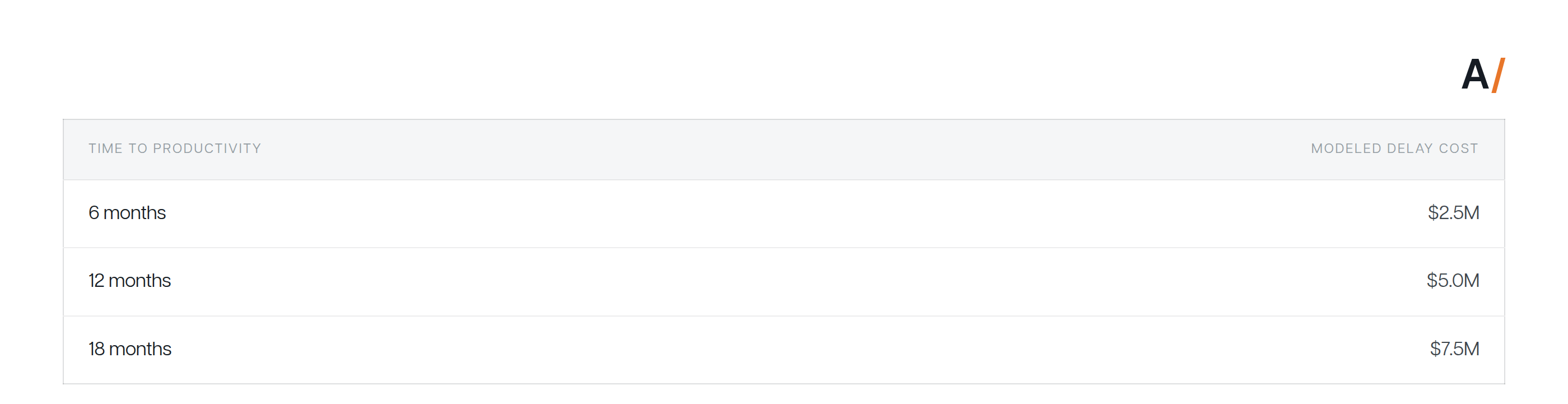
12 months faster preserves about $5 million of modeled economic value, the gap between six months and eighteen.
Every month before capability becomes productive carries an economic cost.
Illustrative. 100 workers required. Each missing productive worker is assigned an annual economic cost of $50,000. Six months is $2.5 million, twelve months is $5.0 million, and eighteen months is $7.5 million.
Under those assumptions, moving one hundred workers from an eighteen-month productivity ramp to six months preserves roughly $5 million of economic value.
The particular number matters less than the relationship. If the economic cost of missing capability is lower, the value of speed falls. If the cost is higher, the value of speed rises.
This is why a company can save money on training while losing far more elsewhere in the business. A cheaper program that takes longer to produce useful capability may simply move the cost from the training budget into operations.
Yield and speed therefore need to be considered together. Yield determines how much productive capability the investment creates. Speed determines when the company begins receiving it.
Together, they determine the real economics of talent.
Scale: when does producing talent become worth it?
None of this means every company should build its own talent system.
Vertical integration carries fixed costs. Developing competency standards, assessments, instructors, equipment, facilities, candidate pipelines, and operating infrastructure requires capital and management attention. At low volumes, those costs may be difficult to justify.
If a company needs ten electricians and the labor market can readily provide them, buying talent is probably more efficient.
The calculation changes when the company needs hundreds of workers every year and the external market cannot reliably supply them.
At that point, dependence on the market has a cost of its own. Recruiting teams search harder for the same workers. Vacancies remain open longer. Compensation rises as employers bid against one another. Contractors and overtime fill gaps. Growth can slow because the company can acquire factories, equipment, and capital faster than it can acquire the people required to operate them.
A controlled talent system has a different cost structure. The upfront investment may be higher, but much of that infrastructure can be reused across successive cohorts. Competency models, assessments, curriculum, equipment, instructors, and operating processes do not need to be rebuilt every time another worker is produced.
The relevant question is therefore not whether producing talent is always cheaper than buying it. It is where the crossover occurs.
Exhibit 10 · Illustrative
The economic crossover point
How the economics of buying talent and producing it change as recurring annual demand grows. No dollar scale: the essay does not provide measured costs at these volumes.
The question is not whether producing talent is always cheaper. It is where control becomes cheaper than continued dependence.
Illustrative conceptual model. Below the crossing, buying may remain more efficient. Above it, recurring demand and scarcity can justify controlling production. The position of the crossing will differ by company, occupation, and geography.
Below that point, the external labor market may remain the more efficient source. Above it, recurring demand and persistent scarcity can make continued dependence on the market increasingly expensive, while the fixed costs of a controlled system are spread across greater output.
The crossover will differ by company, occupation, and geography. It depends on the number of workers required, how often that demand recurs, how scarce the capability is, how expensive vacancies are, how quickly the external market can respond, and how effectively the company's own system can produce talent.
But the economic test itself is simple.
The company should compare the total cost of obtaining a productive worker from the market with the total cost of producing the same capability through a system it controls, and then repeat that comparison at the scale the business expects to require.
The cheapest talent system is not necessarily the one with the lowest tuition, the smallest training budget, or the lowest cost per entrant. It is the one that produces the required amount of productive capability, at the required standard, in the required time, at the lowest total economic cost.
When controlling the production of talent can do that better than repeatedly purchasing finished capability from a constrained labor market, owning the supply stops being only a strategic advantage.
It becomes an economic one.
V. The compounding domination
The economics explain why controlling talent supply can make financial sense. The larger advantage is what that control allows the business to do over time.
Talent shortages are usually treated as a hiring problem. They appear as open requisitions, longer time-to-fill, higher compensation, or increased contractor spend. But when the capability is critical enough, the real constraint is larger. A company can raise capital, build a factory, buy equipment, or adopt new technology, but those investments become productive only when the company has people capable of operating them. Talent can therefore become a ceiling on growth.
Controlling talent supply changes that relationship. In the conventional model, the business decides to open a facility or launch a new operation and then asks Talent to find the people. The workforce requirement arrives after the strategic decision has already been made. If the labor market cannot provide enough qualified workers, the business waits, pays more, or changes the plan.
A company that controls more of its talent production can plan differently. If an expansion will require five hundred technicians in eighteen months, human capacity can be planned alongside physical capacity. The question shifts from whether the company can find enough people to what capability it must produce, and by when.
For Talent leaders, that is a significant change in mandate. The function is no longer responsible only for filling demand created elsewhere in the organization. It becomes part of the infrastructure that determines how much growth the organization can support. The goal is not simply to reduce time-to-fill. It is to ensure that talent does not become the reason the company cannot execute its strategy.
The advantage grows as talent becomes scarcer. Competitors dependent on the labor market can raise wages, hire more recruiters, use contractors, recruit farther away, or poach from one another. Those actions may redistribute the available talent, but they do not create more of it. A company capable of producing additional capability has another option.
Scarcity therefore does not affect every company equally. As the supply of critical talent tightens, companies dependent on finished workers face higher costs and fewer choices. The company with greater control over production is still exposed to the market, but less governed by it.
That is the same principle that made Ivittuut valuable. The importance of controlling the mine increased as downstream industry became more dependent on the scarce input it supplied. Talent works the same way. The more critical, scarce, and difficult to replace a capability becomes, the more valuable control over its source becomes.
Over time, that control reaches beyond Talent. Capital becomes easier to deploy because the company has greater confidence that it can staff what it builds. New technology becomes easier to adopt because the required capability can be developed with it. Expansion becomes easier to plan because human capacity can grow alongside physical capacity.
This is where the advantage compounds. Greater talent capacity supports greater productive capacity. Greater productive capacity supports growth. Growth justifies additional investment in talent capacity, which supports the next stage of expansion.
Competitors may still buy the same equipment, raise capital from the same markets, and build similar facilities. But if their growth depends on a scarce input they do not control, their strategy remains partly conditional on what the labor market can provide.
That is what domination means here. It is not control over workers or the labor market. It is reaching a position where the scarcity that limits competitors limits fewer of one's own decisions.
One company asks whether the market can provide enough talent to support its ambitions. The other increasingly plans the capability required to achieve them.
That difference compounds.
VI. Control the critical input
Ivittuut mattered because an enormous industrial system depended on a small upstream source. Aluminum plants, aircraft factories, capital, and engineering capacity could not compensate for the loss of an input that was difficult to replace. The mine became strategically important because everything downstream depended on what came out of it.
Companies understand this logic when the input is physical. They secure energy, diversify suppliers, reserve manufacturing capacity, protect intellectual property, and vertically integrate when dependence on an outside source becomes too important to ignore. Yet talent is often treated differently. Companies may depend on thousands of technicians, engineers, electricians, machinists, or operators while leaving the production of those capabilities almost entirely to schools, previous employers, and the labor market.
That arrangement works when supply is abundant and responsive. When talent becomes scarce, slow to develop, and essential to growth, the dependency begins to matter.
Competing harder does not solve the underlying problem. Better recruiting, higher wages, signing bonuses, and employer branding can help one company capture more of the existing supply, but they do not necessarily create more of it. The industry can spend more while the number of qualified people remains essentially unchanged.
The alternative is to treat capability as something that can be produced.
That requires more than funding training programs. The company must understand the work, define the capability required to perform it, measure whether that capability has been achieved, and retain enough control over the production system to improve quality and increase output when demand rises.
It also requires economic discipline. Building talent capacity has fixed costs and will not make sense for every role or every company. When demand is small and the market can reliably provide what the business needs, buying finished talent may remain the better choice. But as demand becomes recurring, vacancies become expensive, and external supply fails to respond, the economics of dependence begin to change.
For Talent leaders, this changes the mandate. The highest-value question is no longer simply how to fill requisitions faster. It is whether the company will have the human capability required to execute its strategy.
That means talent capacity belongs in the same conversation as factories, equipment, capital, and technology. If the business plans to grow, the people required to make that growth productive cannot remain an assumption made after the plan is approved.
This is ultimately what it means to own the supply. It does not mean owning people. It means refusing to leave a critical input entirely outside the company's influence when that dependency begins to constrain what the business can become.
The companies that understand this will still recruit. They will still partner with schools, hire experienced workers, and participate in the labor market. But they will no longer accept the existing supply of talent as a fixed boundary around their ambitions.
Industrial power has always depended on control over critical inputs. Talent should be treated no differently.
The conventional company competes for talent. The exceptional company creates its own supply.