The whole country is trying to reopen its factories at once. Capital is back. Contracts are signed. And every operator runs into the same wall: the people who can run the work don't exist in the numbers the work requires. So they reach for the fastest fix — a staffing agency, a recruiter, a higher offer to a competitor's machinist.
It doesn't hold. Here's why, and here's the math.
Rent, buy, build — what each one really gets you
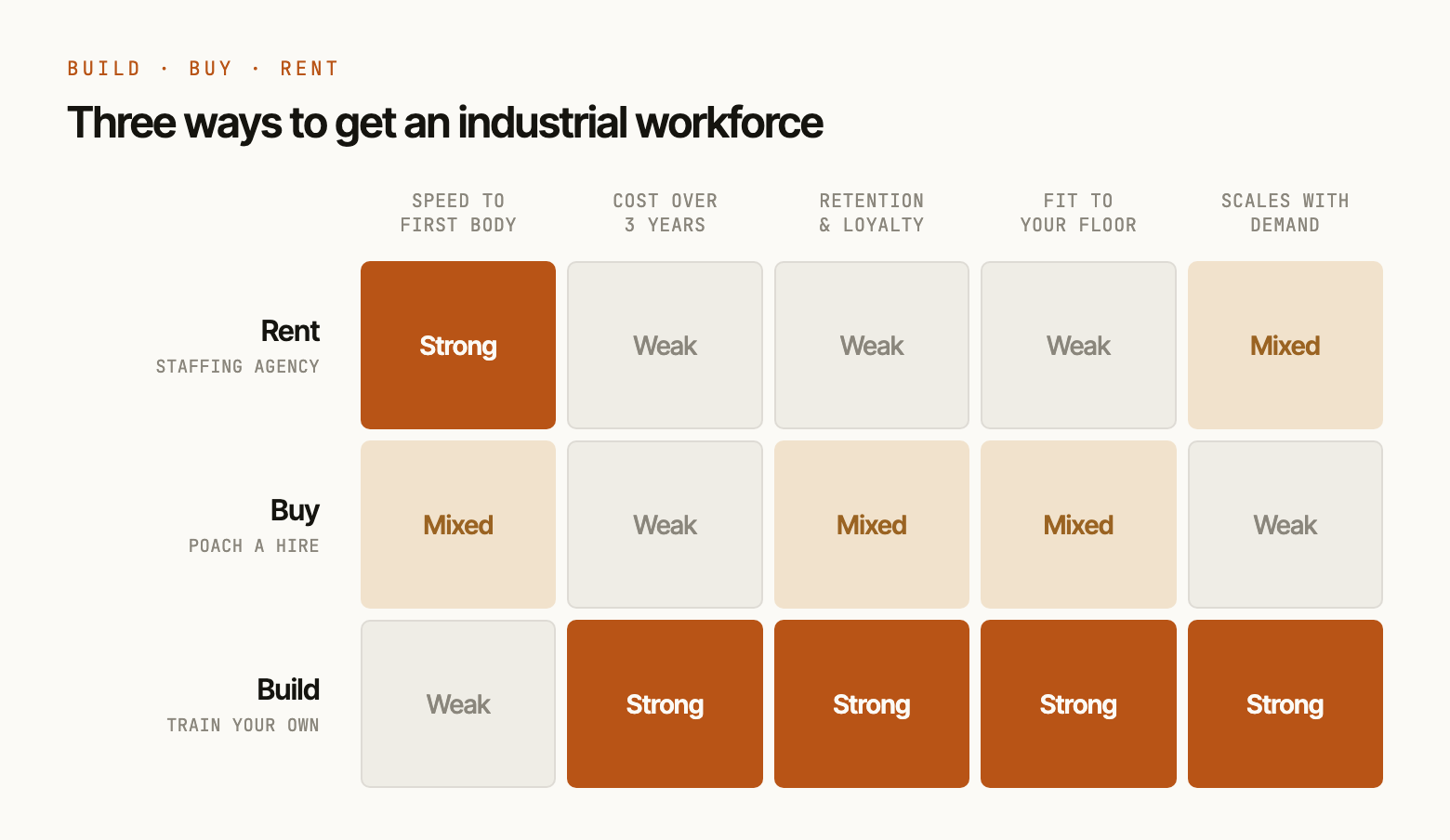
Rent is fast and nothing else. A staffing agency can put a body on the floor this week. But you don't control the skill, the loyalty, or the fit, and the meter never stops running. Temp markups run 25–40% over wage; light-industrial markups reach 35–60% (The Resource Company, 2025). You rent the same seat forever and never own it.
Buy means poaching someone already trained — paying a premium to move a machinist from the shop down the road. It works once. It doesn't scale, it starts a wage war you'll keep losing, and it adds zero net workers to the economy. You moved a chess piece. The board is still short.
Build is the only option that ends with more skilled people than you started with. It's slower to the first body — and it wins everything after: cost over time, retention, fit to your exact floor, and the ability to scale as you grow.
Rent and buy fight over the same shrinking pool. Build makes the pool bigger.
You can't rent or buy what doesn't exist
Here's the part the staffing pitch skips. Renting and buying both assume the worker already exists somewhere — you just have to find them. For the industrial trades, that assumption is false.
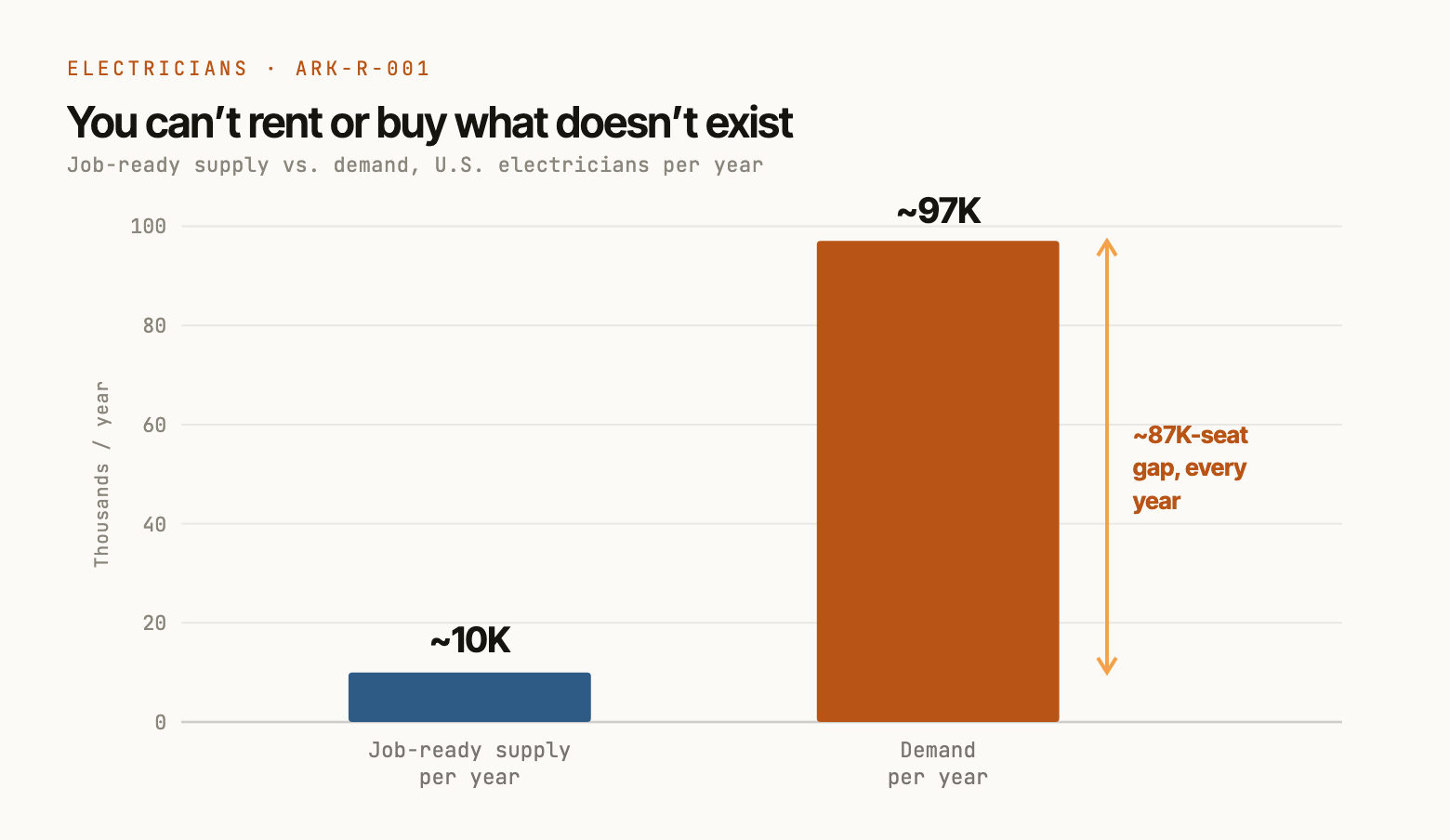
The United States produces roughly 10,000 job-ready electricians a year against demand approaching 97,000 — an 87,000-seat gap that widens every year (Arklight ARK-R-001). Machinists and welders and fabricators show the same shortfall. Two million skilled manufacturing roles are projected to go unfilled this decade.
You cannot recruit your way out of a number like that. Neither can the agency. When the worker doesn't exist, the only move left is to build one.
What renting costs you while you wait
Renting feels cheaper because the cost hides in plain sight. It doesn't.
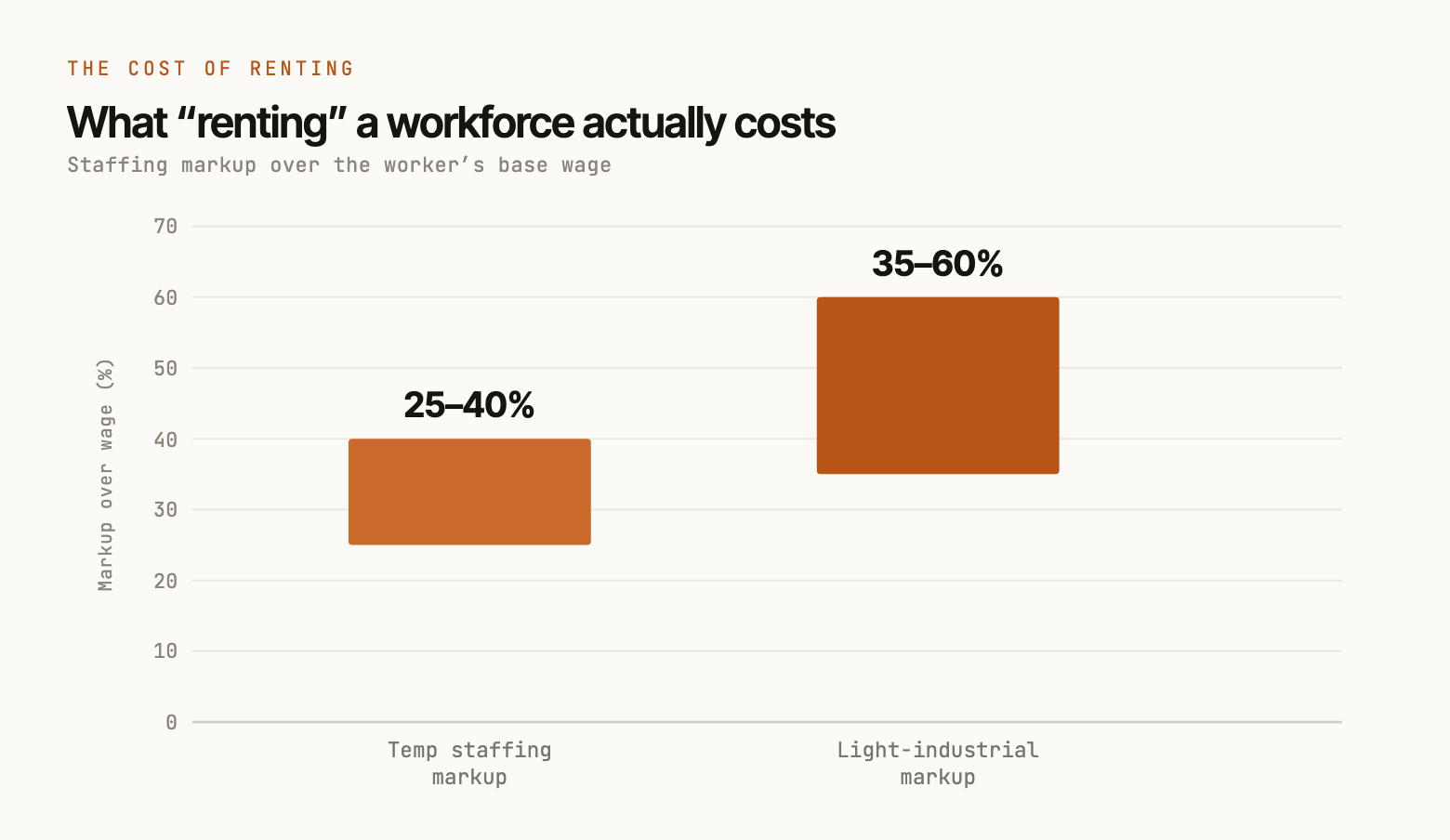
Manufacturing turns over about 28% of its people a year; production roles run 30–38% (The Resource Company, 2025). Every skilled worker who walks costs $10,000 to $40,000 to replace — roughly one to two times salary, per Gallup. Rent enough seats at a 40% markup, churn a third of them a year, and you're not saving money. You're financing someone else's business and calling it a labor strategy.
A built workforce inverts every one of those numbers. People you trained to your floor, on your equipment, stay — skilled-trades turnover runs 10–16%, less than half the line-worker rate. You stop paying the markup. You stop paying the 90-to-180-day ramp on hires who may not last. You own the seat.
How you actually build one
Building sounds slow because the old way was. Two years in a classroom on equipment a generation behind your floor, no guarantee anyone shows up at the end. That's not building. That's college with a wrench.
Trade School 2.0 is a factory with a school inside it. Assess people on what they can actually do. Train them on live production, to your spec, with military methodology and AI doing the heavy lifting on measurement. Deploy operators who ship on day one — and keep compounding as your floor grows. You don't wait two years. You build the pipeline once and it keeps producing.
That's the difference between renting a workforce and owning one.
The bottom line
Rent when you need a body tomorrow and don't care what happens after. Buy when you can win a one-time poach and don't mind the wage war. But if you're trying to scale a floor through a structural labor shortage — the actual situation almost every American manufacturer is in — there is one answer. You build. It's the only path that ends with a country that has more builders than it started with.